
Quorum Sensing: Bacteria’s "Democratic" Decision-Making Process
This article is based on the fourteenth TNQ Distinguished Lecture by Professor Bonnie Bassler and research on quorum sensing.

Ananthapathmanabhan
Multimedia Producer and
Science Communicator
19-August-2026
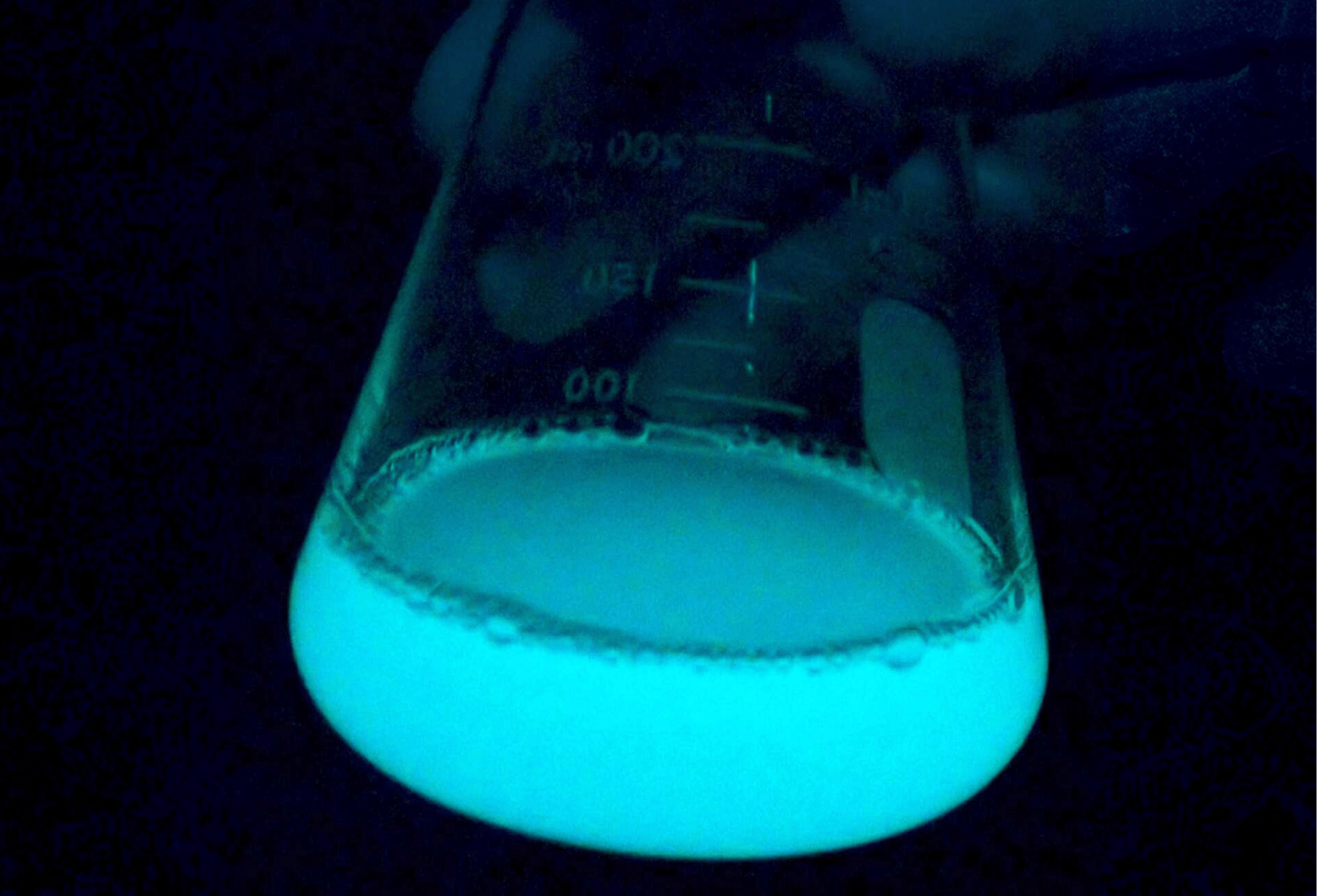
Flask of luminous bacteria. Wikimedia Commons. CC-BY-SA 4.
It’s been more than fifty years since science took the first step to answer “how do bacteria talk?”
“They are multilingual,” says molecular biologist Bonnie Bassler while speaking at the fourteenth edition of the TNQ Distinguished Lectures in Life Sciences.
A few minutes into the talk, she drops the word “Quorum Sensing” (QS), a term first used by Steven Winans to describe bacterial communication in 1994. Since then, Bassler has been in the same league of people who were always curious about one puzzle.
“Individually, bacteria are too small to make a difference,” says Bassler. But the answer to how exactly a puny bacterium can help us live or kill us mercilessly remained elusive. The power lies in their talent to efficiently gang up and talk to each other.
Understanding these bacterial conversations will lead us to answer fundamental questions, including new ways of looking at drug design.
A hundred-year odyssey
In 1965, Alexander Tomasz gave the first experimental demonstration of bacterial communication in Streptococcus pneumoniae as he was understanding the process by which bacteria take up DNA from their environment. In this ‘competence mode’, bacteria make sure the cells are permeable to DNA. He found that all these cells released an activator similar to a hormone at the same time, revealing a synchronicity in bacterial culture. These hormone-like activators, or autoinducers, are predominantly responsible for the competency in all cells. In fact, before the term quorum sensing, ‘autoinduction’ was used to describe cell-to-cell communication.
Historically, the revolutionary field of quorum sensing emerged from studying a harmless, “obscure” bacterium, Euprymna scolopes, popularly and fondly known as the Hawaiian bobtail squid.
The smart squid work their way through, managing to make a deal with the massive colony of bioluminescent bacterium Vibrio fischeri living inside the squid. As the squid senses the light from the night sky, they widen their backs, and the bacteria emit light that matches the luminescence of the sky to counter-illuminate.
The squid stays invisible to predators and make more progenies. Bacteria also benefit from multiplying and being fed as there are more squid.
In 1970, Woodland Hastings and his team showed that bioluminescent bacteria such as Vibrio fischeri produced light only when the population reached a certain density.
The first bioluminescent bacterium was discovered in the 1880s by microbiologists Martinus Beijerinck and Bernard Fischer. But it took almost a hundred years to fully understand that bacterial populations produced light only after talking to one another through the chemical communication process.
When there is higher bacterial cell density, the extracellular concentration of the chemicals that bacteria release increases. As the concentration hits a particular threshold, bacteria detect and sense they have neighbours around.
“We now understand that bacteria must be able to distinguish times when they are alone from times when they are in groups and behave differently under those two scenarios,” says Bassler.
Bassler’s group identified that quorum sensing is not just an idiosyncratic trait of harmless Vibrio fischeri. In fact, the team identified QS as a norm in the bacterial world, which uses a quarter of bacteria’s genes as part of the process.
Bioluminescence is one such manifestation of QS.
A ‘quench’ to eavesdrop
Scientists have vigorously done their spy work to probe into bacterial conversations, to understand the chemical pathways and how they are regulated among bacteria. Next, they turned to disrupt the conversation.
When the bacteria reach a threshold population, the group either goes into attack mode, releases toxins, or goes into defence mode by forming protective biofilms.
Quorum quenching is a process that shuts down their “chit-chat” mainly by using two methods — enzymatic and receptor-blocking quorum quenching.
In the enzymatic approach, specific enzymes degrade the signalling molecules, so they do not reach the concentration threshold, thereby preventing quorum sensing. Whereas in the receptor method, chemical compounds compete, block or inactivate the autoinducers (chemicals) and prevent the bacteria from picking up the signals.
Such manipulating approaches, known as Quorum quenching (QQ), are not intended to kill bacteria, but to limit the emergence of resistance.
For example, lowering drug resistance using quorum sensing inhibitors by disarming virulence. Another application could be in coating medical implants, catheters, and wound dressings with signal-degrading agents to stop harmful bacterial buildup.
“There is a huge amount of energy in the field to be able to manipulate quorum sensing. That is to make harmful bacteria not be able to talk to each other, to make good bacteria be able to chitchat even better,” Bassler adds.